
Hygienic Process Engineering
Zero-Crevice Craftsmanship Engineered for Zero Plant Downtime
In food, dairy, and beverage manufacturing, product contamination from irregular weld seams, dead legs, or incomplete CIP drainage is a multi-million-dollar operational risk. Building process equipment directly on the plant floor causes prolonged shutdowns, dust contamination, and unpredictable quality.
MBH Solutions shifts up to 80% of construction off-site into our clean manufacturing facility. We fabricate modular process skids, pre-welded piping spools, and jacketed vessels under controlled conditions, performing full factory acceptance testing (FAT) before the equipment ever reaches your loading dock.
Our turnkey engineering approach unites mechanical vessel fabrication, sanitary orbital welding, and Siemens automation under a single contract, eliminating vendor finger-pointing between mechanical builders and control system integrators.
Core Capabilities
Comprehensive Process Equipment & Fabrication Services
Explore the technical engineering specifications of our shop-built vessels, modular skid assemblies, and orbital piping.
Sanitary Stainless Tanks & ASME Pressure Vessels
ASME Sec VIII · Jacketed VesselsCustom engineering and fabrication of atmospheric storage, vacuum deaeration vessels, and high-pressure process tanks from 500 L pilot units up to 100,000 L field silos in certified AISI 304L and 316L stainless steel.
We fabricate single-wall holding tanks, insulated storage silos, aseptic surge tanks, continuous pasteurisation holding tubes, vacuum deaerators, and chemical concentrate storage vessels engineered specifically for aggressive CIP reagents.
Precision laser-welded dimple jackets and half-pipe coils designed for operating pressures up to 10 bar. Optimized for high-velocity chilled glycol, cooling tower water, or culinary steam with zoned heat-transfer jackets for precise temperature staging.
Custom-designed mixing systems including high-shear rotor-stator bottom emulsifiers for rapid powder dissolving (pectin, sugar, milk solids), magnetic hermetic drives for zero-leak aseptic operations, and top-entry anchor sweep agitators with food-grade Virgin PTFE wall scrapers.
Fully seam-welded 304 stainless steel outer sheathing with zero pop-rivets or silicone caulking, eliminating moisture penetration into mineral wool or polyurethane insulation during high-pressure sanitary plant washdowns.
Turnkey Modular Process Skids & Systems
Plug-and-Play · 70% Less Plant DowntimePre-engineered, fully automated process skids manufactured in our controlled facility. Skids arrive on-site pre-piped, pre-wired, and wet-tested, reducing on-site tie-in timelines from several weeks to a single scheduled shutdown window.
Single, dual, and multi-circuit Clean-in-Place stations featuring automated chemical concentrate dosing, inline plate/tubular heat exchangers, automated acid/caustic wash cycles, and conductivity-controlled rinse water recovery loops that slash water consumption by up to 35%.
High-throughput continuous dissolving units equipped with Fristam or Hilge high-shear powder induction mixers. Capable of preparing 65° Brix simple syrup continuously up to 40,000 L/h with automated closed-loop Maselli optical refractometer Brix locking.
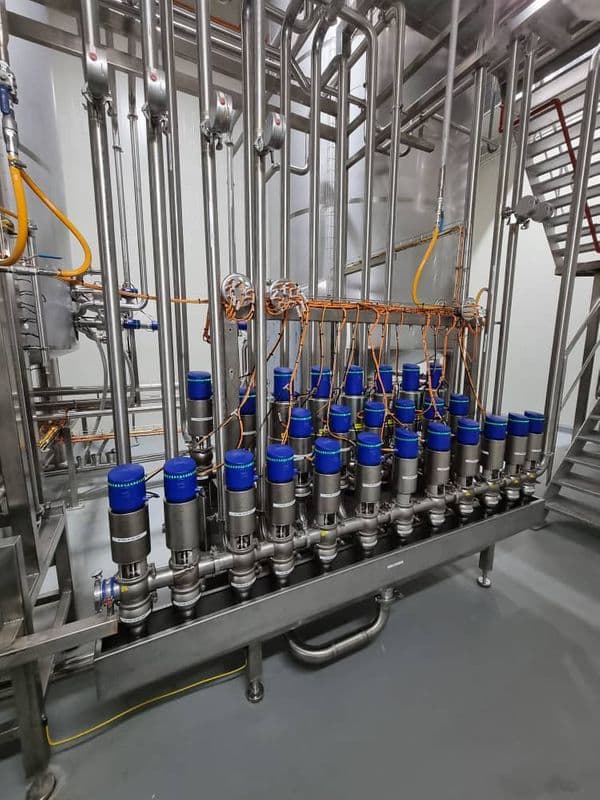
Compact matrix blocks utilizing GEA or Bardiani double-seat mixproof valves with integrated physical leakage cavities. Enables simultaneous product transfer on Line A while conducting active 85°C caustic CIP sanitization on Line B with zero contamination risk.
ATEX / HazLoc Zone 1/2 rated chemical dosing skids with Endress+Hauser Promass Coriolis mass flow meters, high-viscosity progressive cavity or positive displacement pumps, and Danfoss VFDs for micro-ingredient precision.
ASME BPE Sanitary Piping & Orbital TIG Welding
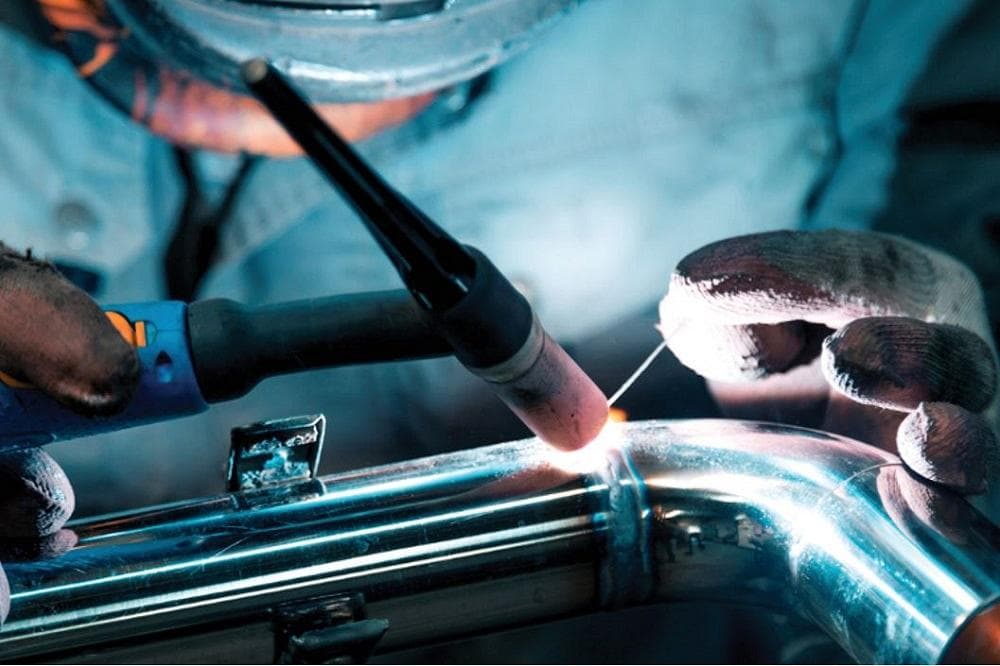
ASME BPE · < 20 ppm O2 PurgeHigh-purity hygienic fluid transfer demands perfectly flush, crevice-free internal weld beads that eliminate bacterial biofilm harborage. We utilize computer-controlled closed-chamber orbital GTAW/TIG welding with automated parameter data logging.
Utilizes microprocessor-controlled orbital weld heads with synchronized pulse current, rotation speed, and arc voltage control. Guarantees 100% full-penetration, flush internal weld profiles compliant with ASME BPE weld acceptance criteria.
Welds are backed by 99.999% ultra-high purity argon purge gas monitored with calibrated digital optical oxygen analyzers. The weld arc is inhibited until the internal oxygen concentration drops below 20 ppm O2, completely preventing heat tint and sugar-rogging.
We procure low-carbon 316L (1.4404) tubing with tightly controlled sulfur content between 0.005% and 0.017%. This balances surface tension gradients (Marangoni convection) in the molten weld pool, preventing asymmetrical or wandering weld penetration.
Complex piping geometries are extracted from 3D laser scans and prefabricated into spool assemblies under cleanroom shop conditions. Each spool is hydrostatically tested, marked with unique weld IDs, and passivated before delivery to the site.
Surface Engineering, Chemical Pickling & ASTM Passivation
Ra < 0.4 µm · ASTM A967Mechanical cutting and welding deplete protective chromium oxides from stainless steel. We execute certified chemical surface treatments to restore passive oxide films and guarantee maximum corrosion resistance under aggressive CIP chemicals.
Multi-stage grit mechanical polishing achieving Ra < 0.8 µm (32 µin) sanitary food standard and ultra-smooth Ra < 0.4 µm (15 µin) high-purity finish. Internal surface roughness is verified and certified using calibrated Mitutoyo digital surface profilometers.
Application of pickling pastes and immersion baths per ASTM A380 to dissolve heat-tint discoloration, free-iron inclusions, and micro-weld spatter, exposing raw unadulterated base metal.
Total chemical passivation utilizing formulated nitric or citric acid solutions. This selectively leaches free iron from the stainless surface while enriching chromium content, accelerating the formation of a dense, corrosion-resistant Cr2O3 passive layer.
Surface cleanliness is validated via ferroxyl swab testing for free iron detection and high-humidity test chambers. A formal Passivation Certificate of Compliance is issued for every vessel and piping spool.
On-Site Mechanical Erection, Rigging & Turnkey Tie-Ins
Turnkey Mechanical InstallationOur factory-trained mechanical crews manage complete on-site rigging, vessel erection, structural platform assembly, and utility integration with minimal disruption to ongoing production operations.
Execution of complex vessel rigging through existing plant roof openings or restricted access corridors utilizing hydraulic gantry systems, heavy-duty machinery skates, and laser alignment tooling.
Complete fabrication of plant utility infrastructure: high-pressure steam distribution (ASME B31.1), steam pressure reducing stations, condensate return loops, chilled glycol piping, sterile compressed air, and reverse osmosis (RO/WFI) loops.
Fabrication of sanitary stainless steel catwalks, mezzanines, access stairways, and overhead pipe bridges in bead-blasted or polished 304 stainless steel, engineered without unsealed hollow sections to prevent hidden water accumulation.
Turnaround tie-ins executed during scheduled 48-to-72-hour plant shutdowns. Multi-disciplinary teams work continuous shifts to complete final cut-ins, flange connections, hydrostatic pressure tests, and CIP sanitization flushes.
Metallurgy & Material Selection
Alloy Selection for Chemical & Thermal Compatibility
Choosing the correct stainless metallurgy prevents pitting corrosion, stress cracking, and product degradation.
AISI 304 / 304L
PREN 18 – 20Ambient sugar syrup storage, dairy raw intake, deaerated water holding, skid structural framework, and utility piping.
Excellent formability and general atmospheric corrosion resistance; cost-effective solution for non-acidic process zones.
AISI 316 / 316L
PREN 23 – 25Carbonated beverage lines, acidic juices, hot caustic/acid CIP loops, dairy pasteurizers, and sanitary piping.
Molybdenum addition provides superior resistance to pitting and crevice corrosion under hot chemical CIP conditions.
AISI 904L / Hastelloy C-22
PREN 35 – 45+Hot brine marinades, high-chloride food seasonings, concentrated phosphoric acid degumming, and aggressive pickling lines.
Virtually immune to chloride-induced stress corrosion cracking and extreme acid pitting at elevated process temperatures.
SEAL.SPECSanitary Seal & Gasket Compatibility
Culinary steam, hot caustic wash (NaOH), hot water, and non-fatty beverages. Excellent ozone and heat resistance.
Edible oils, fatty milk solids, essential oil flavor concentrates, and hydrocarbons. Resistant to animal fats and oils.
Universal chemical inertness. Used in scraper blades, valve seats, and high-purity sanitary gasket envelopes.
Engineering Standards
Manufacturing Tolerances & Inspection Specifications
| Engineering Parameter | MBH Quality & Compliance Specification |
|---|---|
| Material Metallurgy | AISI 304, 304L, 316, 316L, 904L & Hastelloy C-22 (with EN 10204 3.1 MTRs) |
| Design Codes & Standards | ASME BPE, ASME Section VIII Div 1, ASME B31.3 / B31.1, EHEDG & 3-A Sanitary |
| Welding Technology | Automated Closed-Chamber Orbital TIG (GTAW) & Manual Sanitary TIG per ASME Section IX |
| Inert Purge Quality | 99.999% High-Purity Argon with real-time digital oxygen monitoring (< 20 ppm O2) |
| Internal Surface Finish | Mechanical Polish Ra < 0.8 µm (standard) / Ra < 0.4 µm (high-purity / electropolished) |
| Chemical Passivation | Nitric / Citric Acid Chemical Treatment per ASTM A380 / ASTM A967 with Ferroxyl validation |
| Non-Destructive Testing (NDT) | 100% Video Boroscopy, Hydrostatic Pressure Testing (1.5x Design Pressure), Dye Penetrant (PT) |
| Turnover Documentation (TOP) | Complete Dossier: MTRs, Weld Maps, Boroscope Video Logs, Hydro-Test Charts, FAT Protocols |
Audit-Ready Documentation
Turnover Package (TOP) Dossier Deliverables
Every fabricated vessel and skid arrives with complete certification packages required for multinational QA sign-offs and regulatory validation.
Certified Mill Test Reports (MTR 3.1)
Full EN 10204 3.1 certification verifying heat numbers, chemical analysis, and mechanical tensile strengths for every sheet, pipe, and flange.
Weld Procedure & Welder Qualifications
Complete Welding Procedure Specifications (WPS), Procedure Qualification Records (PQR), and Welder Performance Qualifications (WPQ) per ASME Section IX.
Weld Identification Map & Joint Log
Detailed 3D isometric drawing linking every physical joint to its assigned weld ID, welder number, date of execution, and boroscopic pass status.
100% Video Boroscopy Digital Package
High-definition video files of all internal orbital welds provided on digital media, showing full 360-degree internal bead profiles.
Hydrostatic Pressure Test Certificates
Certified test chart logs recording test pressures held at 1.5x design ratings for 60+ minutes with calibrated test gauge serials.
Surface Roughness (Ra) Test Sheets
Digital stylus profilometer reports certifying internal surface finishes at critical vessel and piping measurement points.
Passivation Certificate of Compliance
Verification records detailing acid chemistry, exposure durations, rinse water pH neutralization, and negative ferroxyl test results per ASTM A967.
As-Built P&IDs & General Arrangement CAD
Final red-line updated Process & Instrumentation Diagrams (P&ID) and 3D CAD models detailing all final tie-in dimensions and nozzle coordinates.
Quality Assurance Protocol
From 3D Spool Modeling to Commissioned Reality
Every skid and vessel is manufactured under a certified Quality Plan ensuring 100% compliance with client specifications before release.
3D CAD Modeling & Spool Isometric Engineering
Every vessel, skid frame, and piping spool is modeled in 3D CAD to verify nozzle orientations, dead-leg elimination, and human ergonomics before cutting steel.
Cleanroom Shop Fabrication & Orbital Welding
Components are fabricated in our dedicated stainless facility. Certified ASME Section IX welders perform automated orbital welds under continuous argon purge.
Factory Acceptance Testing (FAT) & Hydro-Testing
Complete skid systems undergo simulated water runs, automated valve sequencing, and hydrostatic pressure testing at 1.5x design limits in our testing bay.
Site Rigging, Fast-Track Tie-In & Commissioning
Skids are delivered modularly for swift rigging, utility tie-in, automated passivation flushing, and startup during scheduled plant turnaround windows.
Proven Track Record
Fabrication & Mechanical Erection References
View all project references →Technical Clarity
Frequently Asked Engineering Questions
Q1.What is the operational advantage of automated orbital welding over manual sanitary TIG?
Manual TIG welding relies on human hand speed and torch angle, which can result in inconsistent internal weld penetration, micro-crevices, and excess heat-tint oxidation. Automated closed-chamber orbital welding regulates current, pulse frequency, and travel speed with computerized precision. Under continuous argon purge (< 20 ppm O2), it delivers a perfectly flush, crevice-free internal weld bead that resists bacterial biofilm formation and ensures 100% cleanability during CIP sanitization.
Q2.Why does MBH strictly control sulfur content between 0.005% and 0.017% in sanitary 316L tubing?
Sulfur acts as a surface-active element in the molten weld pool. If sulfur is below 0.005%, Marangoni fluid flow causes the molten metal to spread outward, resulting in wide, shallow penetration. If sulfur exceeds 0.017%, fluid flows deeply downward, causing burn-through. Controlling sulfur tightly between 0.005% and 0.017% guarantees symmetrical, uniform weld pool penetration across all orbital joints.
Q3.How does modular off-site skid fabrication reduce overall CAPEX and installation downtime?
Building process equipment on an active plant floor requires hot-work permits, dust containment tents, temporary scaffolding, and prolonged plant shutdowns costing tens of thousands of dollars per day. With modular skid fabrication, 80% of assembly occurs in our clean facility while your plant continues running. The completed skid arrives pre-piped, pre-wired, and wet-tested. On-site installation is reduced to rigging into position, bolting down, and connecting primary utility tie-ins during a single 48-to-72-hour weekend shutdown.
Q4.What internal surface roughness (Ra) is required for food, beverage, and dairy contact?
For general food and beverage applications, an internal mechanical finish of Ra < 0.8 µm (32 µin) is the recognized sanitary standard under 3-A and EHEDG guidelines. For dairy, baby food, and aseptic processing, a high-purity mechanical polish of Ra < 0.4 µm (15 µin) or electropolishing is recommended to eliminate surface microscopic pockets where proteins and bacterial colonies can anchor.
Q5.How do you verify that Clean-in-Place (CIP) spray balls cover 100% of internal vessel surfaces?
We conduct a Riboflavin Spray Coverage Test compliant with EHEDG guidelines. The vessel interior is completely coated with a fluorescent riboflavin solution and inspected under UV blacklight. The automated CIP cycle is initiated for a timed wash. Post-wash UV inspection verifies that 100% of the riboflavin has been dissolved and removed, proving that there are zero spray shadows or blind spots behind agitator shafts and baffles.
Q6.What documents are included in the Turnover Package (TOP) for multinational audits?
Every project is accompanied by an audit-ready Turnover Package containing EN 10204 3.1 Mill Test Reports (chemical & mechanical properties), Welder Performance Qualifications (WPQ/WPS), 3D isometric weld identification maps, digital video boroscopy recordings of internal joints, certified hydrostatic test chart logs, surface profilometer roughness sheets, and ASTM A967 Passivation Certificates.